
Castle Hayne Chronicles
Author/Artist-in-Residence

With my recent nomination and then appointment as Author-in-Residence at Castle Hayne, (well, yes, self-nominated and self-appointed), I thought it best that I know something more about Castle Hayne. Officially, it is a census-designated-place in New Hanover County, North Carolina, and lies on the banks of the Cape Fear River, a ribbon of blue that winds northward along the west side of Wilmington and then turns to the north and east passes Castle Hayne and eventually disappears, as far as I can tell, into untouched swaths of marshes and swamps with stands of old growth forests. And yes, since early summer, I call Castle Hayne home
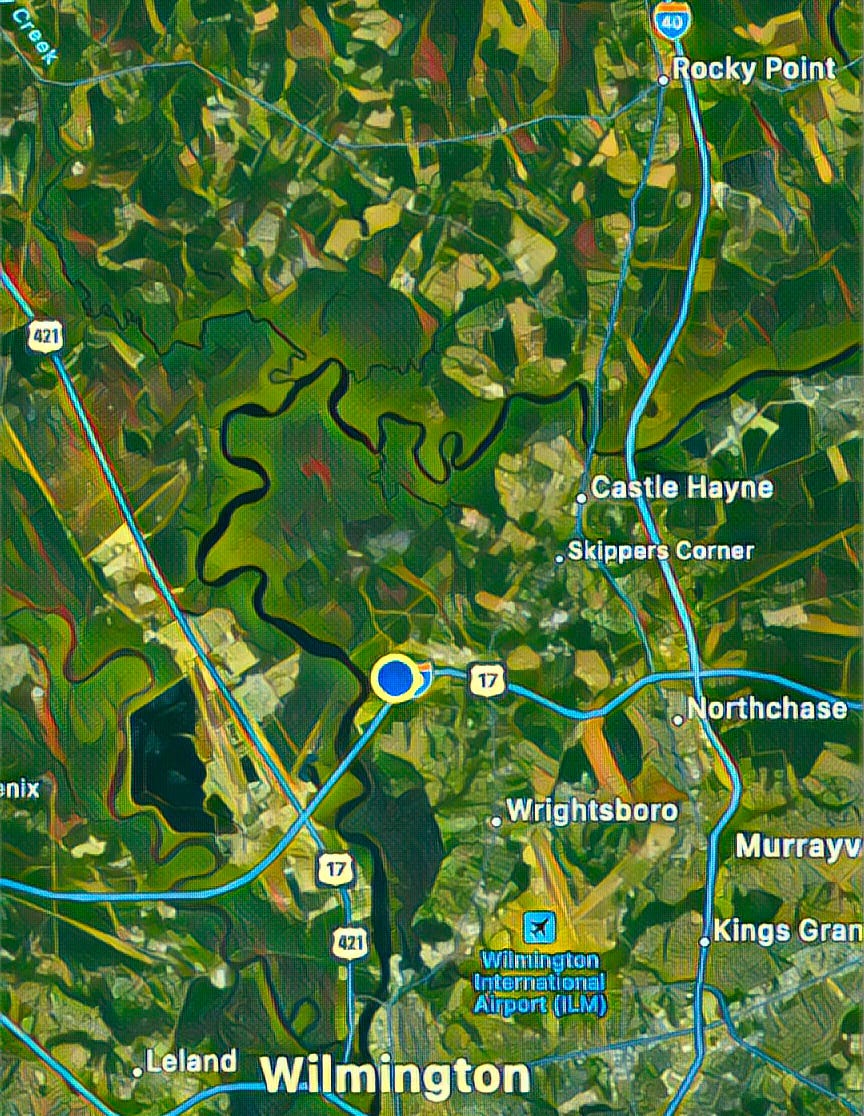
Finding the town center took a while. There’s no city hall, or court house, or shopping district, just a continuous series of businesses along either side of Highway 133, a nine mile swath of asphalt that runs from Wrightsboro to Rocky Point.
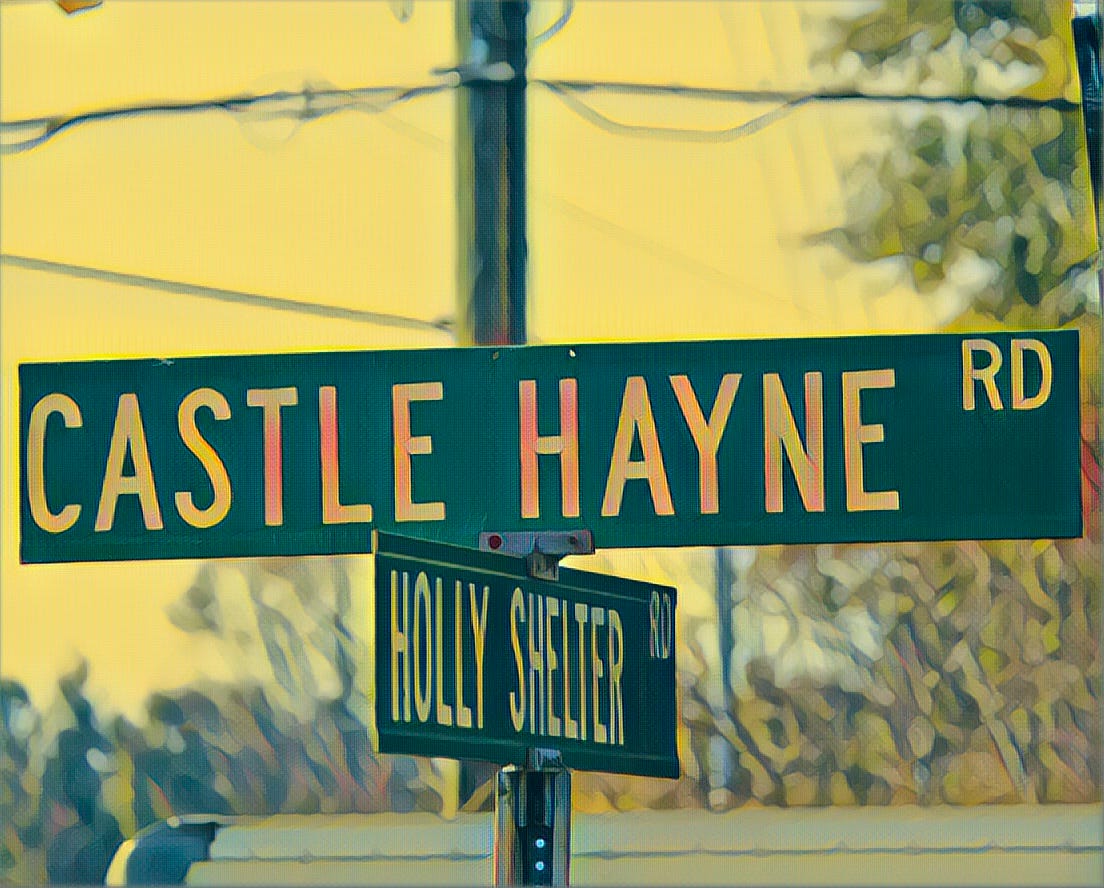
The census reported a population of 1,200 souls in 2010, and despite a great many more people having moved to the area in the decade plus since, my guess is the official count of whatever is included in the CDP is not much greater now. The influx of people like me are here but tucked away in burgeoning communities to the west and east of 133.
The obvious question, or at least the obvious question to me, is “Where is the castle?” Have I missed it as I drove from the Food Lion grocery store in Wrightsboro, past the hundred plus year old Tinga Nursery, the GE Aerospace plant, and the Dolorosa Arabian horse farm, to the Food Lion in Rocky Point?
The answer, yes and no. Captain Roger Haynes bought a 1,000 acre tract of land along the Cape Fear in 1731 and built a large (some say massive) 17-room plantation home which he referred to as his castle. According to local legend, he met an early demise—while suffering with a delirium fever, he woke up, ran to the river to cool off, and drowned.
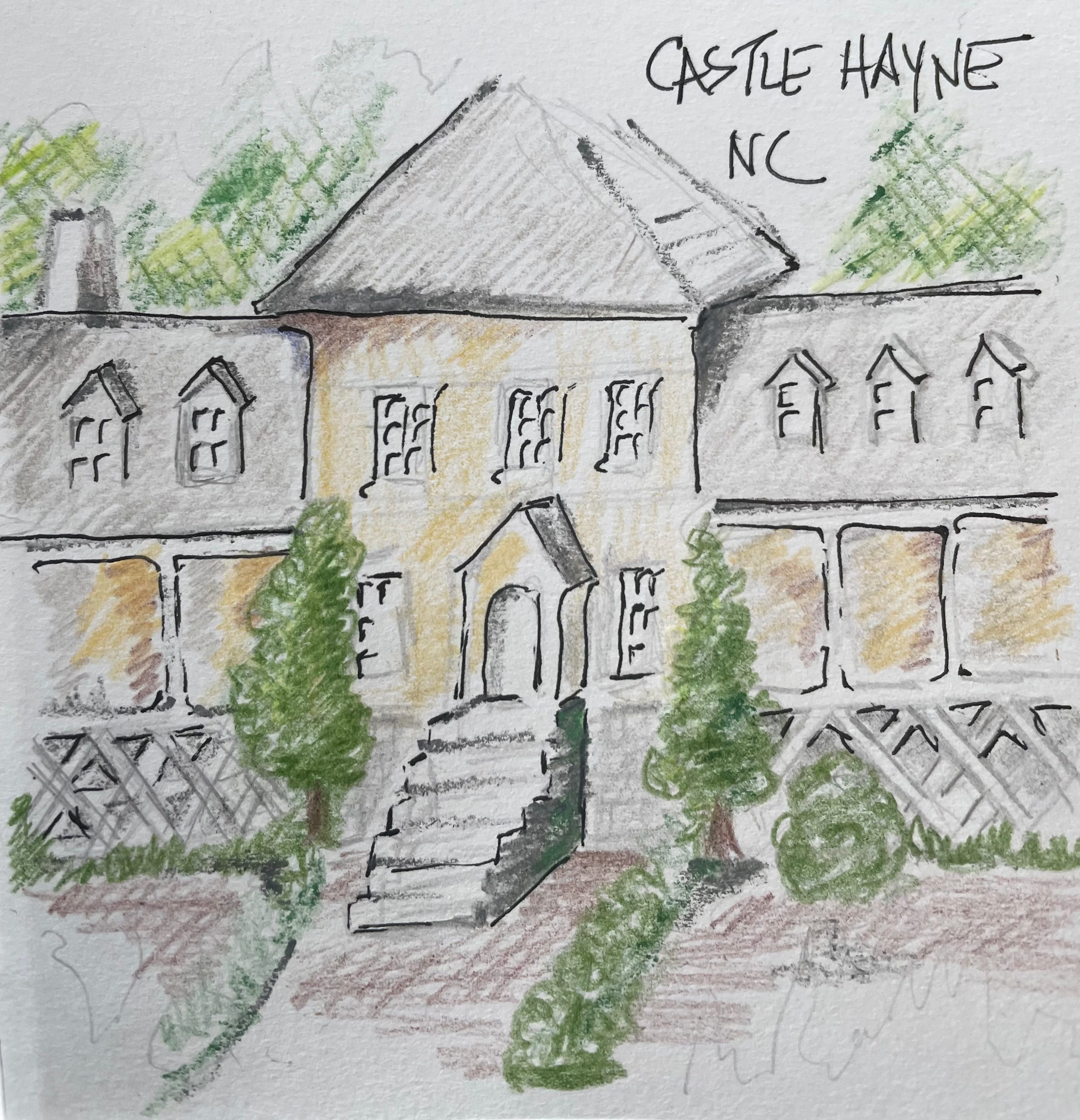
Haynes’s heirs (the Burgwins) moved to an equally massive home in downtown Wilmington, but kept the “castle” as their country home, naming it the “Hermitage.” A succession of Burgwin generations occupied the Hermitage and enjoyed the fruits of its expanding land mass—at one time totaling 4,000 acres. The Hermitage persisted through the Civil War. Then, in 1881, a devastating fire took its toll.
Cue, Hugh MacRae. A prominent landowner and local businessman of the early 1900s, McRae bought much of the Burgwin property and helped build out the area around the Castle Hayne (no “s”) railroad depot in the vicinity of the former plantation. His vision was of an expanse of grasslands on which to graze cattle and raise crops. McRae began recruiting immigrants with knowledge of farming, but the soil in the area proved difficult and the mostly Dutch immigrants struggled to survive. One of the settlers, the Swarts, eventually succeeded, running a dairy and bulb business on the land. D. Swart Sons Bulb Company, as the family enterprise became known, was one of the most successful bulb producers in the area.
I’ve learned there’s a Simmons in the Burgwin-Swart saga, too. But that, along with other interesting aspects of my new “authordom” including the natural beauty of the unspoiled land adjacent to the river, the geologic history, remnants of other historical landmarks, and tales of small-town life will have to wait for future episodes.
P.S. The sketch of Castle Hayne is derived from a vintage drawing. Sketched by me as I practice the artist-in-residence aspect of my appointment with lessons by artists across Substack.
Etcetera
Order copies of my new book, No Average Day: The 24 Hours of October 24, 1944 or contact me for a signed copy.
Come find me on my website (ronasimmons.com) or on Facebook, Twitter, or LinkedIn.
Leave me a comment. I would love to hear what you know about the place you call home.
The Hermitage Plantation and Castle Haynes Plantation were two separate plantations that eventually merged under John Burgwin. But the Hermitage was originally owned my Richard Marsden, who’s daughter, Margaret, married Captain Roger Haynes, and their daughter, also Margaret, married John Burgwin, but she died before they had children. Through his marriage to her, he inherited the Hermitage plantation. The plantation stayed in the Burgwin family for more than 150 years.
We been living in Wilmington, NC for 16 years and I work at GE Vernova Nuclear. Born in Ohio and grew up in Wisconsin, I could not imagine having relations in North Carolina, let alone New Hanover county. Apparently, I have a lot of ancestors in North Carolina. Who knew ??