
The Reading Season
The Soldier’s Truth

As the year comes to a close, I do as I have in the past: I look up from what has kept me occupied (or preoccupied) during the preceding ten or eleven months. I pause to reflect on what I learned, what I accomplished, and what I want to tackle the next year. And, I take note of what I read. This year, I confess, I suffered a reading drought and made only a small dent in my “to be read” stack.
One of the books I did read was The Soldier’s Truth by David Chrisinger, a fascinating account of one of the icons of American journalism and the trials and tribulations of a war correspondent during World War II.
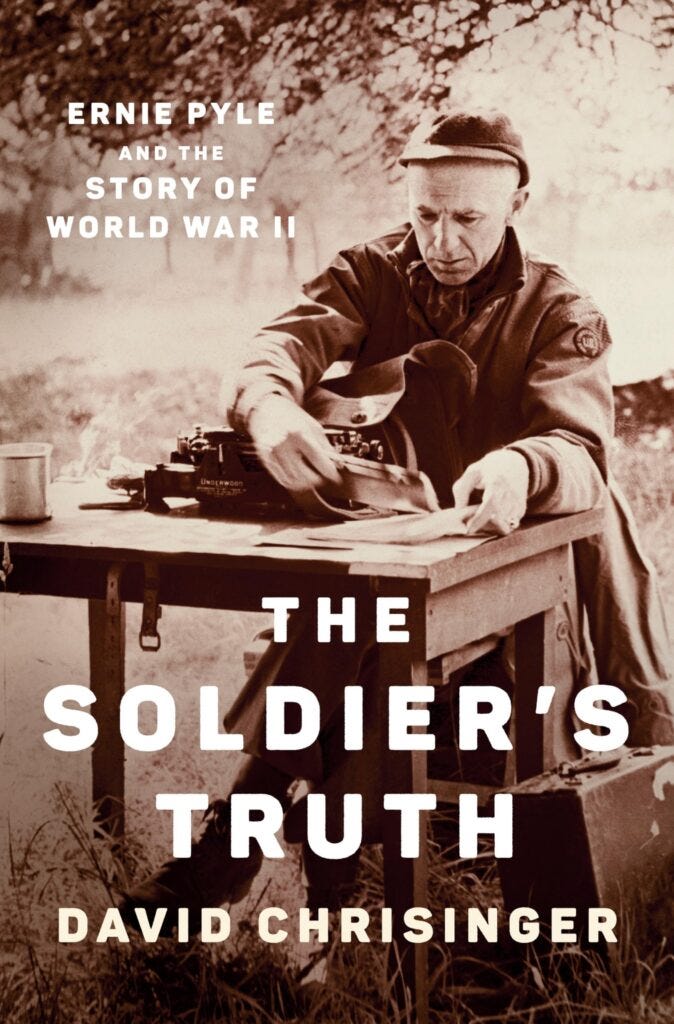
The book is a multi-layered account, as I noted in my review (an excerpt of which follows).
There’s the backdrop of the events of World War II from North Africa in 1942 to the invasion of Normandy in 1944 and to the war in the Pacific in 1945. Woven into this tapestry are two other, equally important narratives, that of Chrisinger following in his grandfather’s footsteps across Europe, as so many veterans’ descendants have done or tried to do, and the tragic love story between Ernie and Geraldine “Jerry” Pyle.
For those who were not alive to read and be comforted by Pyle’s dispatches from the front in their local newspaper during World War II, or who are not familiar with Pyle’s work, Chrisinger offers extracts of Pyle’s letters and numerous quotes. They demonstrate the depth of understanding Pyle acquired and the relationships he established with ordinary soldiers, men he spoke with, followed, and befriended.
Pyle’s words are plain spoken but stirring. They place the reader in the soldier’s shoes, as he scrambles into his shallow foxhole or sprints across the shell-pocked earth: “The front-line soldier I know lived for months like an animal, and was a veteran in the cruel, fierce world of death…He was filthy dirty, ate if and when, slept on hard ground without cover. His clothes were greasy and he lived in a constant haze of dust, pestered by flies and heat, moving constantly, deprived of all the things that meant stability…” (p. 101).
Chrisinger, goes a step further, he insinuates that the description could have been just as easily applied to Pyle himself. He, too, went without comforts correspondents often enjoyed, choosing to eat, smoke, and drink with the troops, and then crawl into a bedroll beside them on the hard ground.
The soldier’s truth, as Chrisinger explains in closing, is that war is hell. But, perhaps one of the most important truths of the book, particularly compared with modern wars, is the sense that the soldiers understood what they were fighting for and why. From airmen he met in England, Ernie learned although “the soldiers didn’t hate the Germans and didn’t like fighting in the war, they ‘understood, the only way out of the war was to fight our way out’” (p. 199). Better still, as Chrisinger quotes Pyle, they did it willingly and with spirit.
You can read the full review where it was originally published, in On Point, The Journal of Army History, here:
https://armyhistory.org/the-soldiers-truth-ernie-pyle-and-the-story-of-world-war-ii-review/
Leave me a comment. Take a moment to tell me what one book you would call out from your reading in 2025. My long list of “to be read” books needs some fresh additions.
Etcetera
Order copies of my new book, No Average Day: The 24 Hours of October 24, 1944or contact me for a signed copy.
Come find me on my website (ronasimmons.com), or on Facebook, Twitter, or LinkedIn.
The service that Ernie Pyle rendered to the. American public and the GI s he shared misery and grief with was priceless and irreplaceable.